
What am I actually doing when I make a picture?

Part One: Beginning + Middle
I'm stepping into a handful of art and illustration projects in this first quarter of the year. Some are deliverables, others are driven more by exploration and skill-building. All projects of my own making.
At this juncture, I feel the strong urge to describe what I’m doing when I make a picture — from coming up with ideas to communicating them and creating a finished picture — naming the steps I’m taking and why they matter.
2026 is shaping up to be a stretch year, and I want a clear record of how I’m working at the beginning of it — a point of reference I can return to when my picture-making shifts.
What follows is for me — for clarity. Knowing where I am in my process as I go along boosts the experience itself. It’s exciting when things happen.
So, keeping things simple — here’s a snapshot of how I’m approaching the beginning, middle, and end of making a picture right now. This first post focuses on the first two steps in my process; the last step will be picked up in part two.
First, before even beginning, a quick note —
The process looks a little different depending on what I’m making — illustrated journal entries, yard signs, or pictures meant for the wall— mostly in how deeply I move through each phase. Yard signs tend to require the most deliberate structure. Illustrated journal pages are lighter and faster. Painting sometimes grows out of this process, and sometimes begins somewhere else entirely. For this post, I’m describing the shared structure underneath all of them.
Beginning — coming up with an idea
(Making connections, drawing relationships)
Working small, the sketchbook is a place to start ideation, but not necessarily to finish it.
I work small-ish and fluidly from page to page. I start with words — brainstorming and free association, building word stacks around opposing ideas — looking for possible elements of a story, as well as relationships or metaphors.
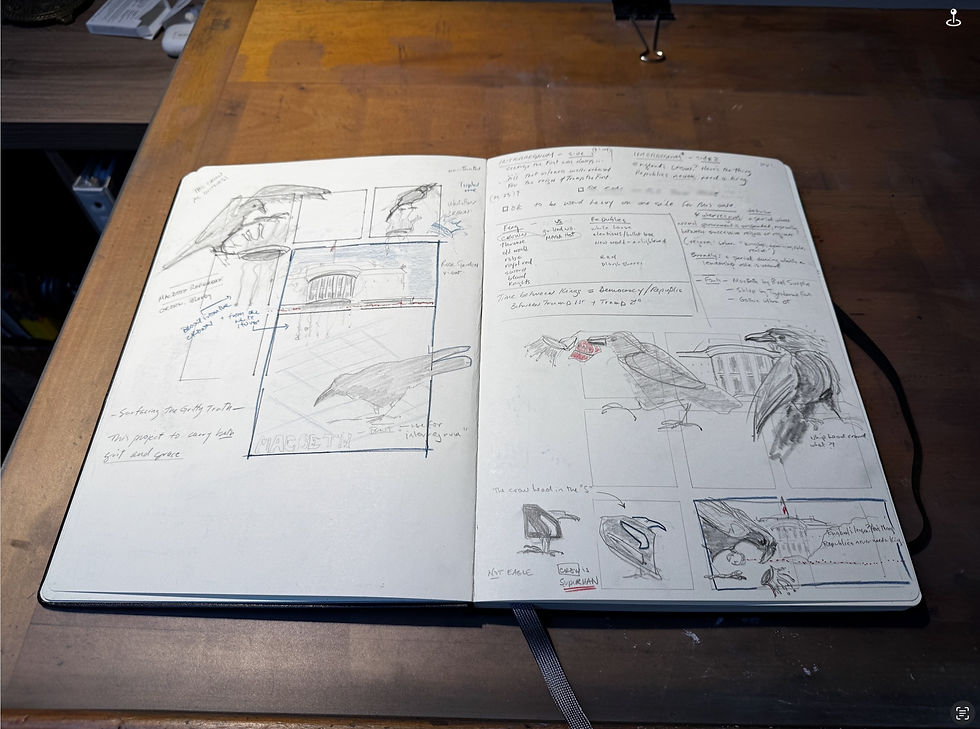
Then, in pencil, I draw potential elements (a crow, a building, a flag, for example) that stand in for ideas from the word stacks. If a given building isn’t familiar, reference images help establish basic shapes from a few angles. From there, I explore different ways these elements might relate to one another, moving them around and shifting scale. These first drawings focus on finding relationships, alignments, and shapes.
Mostly, I’m drawing to find what excites me — and to choose a direction worth pursuing.
Middle — Exploration to commitment
(Establishing structure and hierarchy)
At this point, I aim to be drawing within a box that matches the proportions of the final picture.
I gather my chosen elements and test tensions and possible relationships within the box's limits — trying close-ups or distance, points of view, silhouettes, and negative space. This can be very frustrating. I try different shape configurations within the box (dividing the two-D space), and focus on hierarchy. What I’m feeling for is a visual structure that can carry the idea.
But very often, I get stuck before landing on a value sketch (thumbnail) that works.
Usually, for one of two reasons: First, I get wrapped up in the specifics of the things I’m drawing and forget I’m working more abstractly with shape and association. When that happens, it’s hard to design hierarchy.
Second, I didn’t find enough clarity earlier while sketching the concept, so I end up going in multiple directions at once instead of taking up one idea at a time. I lose focus, and the drawing wanders without anything coming together.
To break through, I’m learning to pause and shift how I’m working — rather than throw my pencil across the room.
Here are a few ways —

Stand up at the easel — draw bigger.
Working at 18 x 24 inches changes the physicality of the drawing. Sawing lines and gesture drawing with charcoal help me find space within the picture, as well as shapes that can merge into larger masses.
Stand at the drawing table — work with my blunt tools.
Shape drawing with pan pastel (using the sponge), a stick of square charcoal, a brayer, or a 2-inch flat brush with ink lets me work directly with mass and value. Am I working low, middle, or high key? Overlapping elements and drawing through elements become inevitable — and useful.
Both approaches get me to step back and loosen up. They’re fast, embodied forms of thinking. Then I walk away. When I return to what’s on the easel or table, the next step — zeroing in on what’s working, or cropping, for example — often becomes obvious.
From there, I either pull the work back into a small thumbnail (this’ll be ridiculously simple — at last) or the larger piece I’ve started moves toward a finished picture.
End — Refinement and Finish
(A way of finishing or declaring it done)
At this point, I’d love to describe the End phase of my process — how I use references, select materials, and approach rendering. But that part of the process is still under active development and warrants a separate, thoughtful blog post.
What I can say is this: with materials like ink, monotypes, pastels, and charcoal, the finish emerges through the act of working them. I begin by focusing on the initial layer — establishing mood, value, and energy — so I have something to respond to. In some cases, when I’m already working with my materials in the middle (exploratory) phase, I can move directly into a finished picture, finding the level of abstraction or rendering quite quickly. So the End doesn’t feel like a single, fixed step yet.
That’s where I’ll stop.
In Part Two, I’ll focus on the End phase itself: what I’m learning about finishing, why my first layer matters so much right now, and what I care about — not just in terms of output, but in how I want the work to feel as I make it.
What matters most, in the end, is whether I’m finishing more — and more successful — pictures in 2026.




Comments