
Whatever it Takes to Finish
- Jun 11, 2024
- 5 min read
Neil Gaiman lays it out plainly —
You have to finish things —
that's what you learn from, you learn by finishing things.
Whatever you have to do to finish it, finish it.
Advice to Aspiring Writers
These words — taken to heart this week: Let’s see what I can finish with the brayer, paint, charcoal, pastels and animals. No expectations other than keeping track and aiming for at least one lesson for each picture.
Set up — Work on big paper, with a simple thumbnail to get started.
Paying attention to — ∎ the paper and materials ∎ what is working, what’s temperamental ∎ the highlight of making it ∎ the problems and possible solutions. And, if I can catch them, ∎ the thoughts and snippets of story that come up as the picture evolves.
Starting with two pictures I want to “fix” — that is, do whatever I have to do to call them finished.

The Rat and the Crows
Can I fix this and finish?
Drawing paper, more cream than white. 14 x 17.
Brayer, paint, homemade bird stencils, pan pastels.
Highlight: the rat’s expression
Problems: Heavy handed drawing. The brayer leaves geometric marks — not what I want in the sky. Don’t like this paper (not white enough and it doesn’t erase well).

Solutions: ∎ Work with the picture in Procreate — knock back the sky and the crows, mess up edges in hills, add a bit of texture. ∎ Cropping — portrait and landscape. Landscape works better, I think.
Dare I do these same adjustments on the original? Not sure how with my materials. Try anew on the new Pacon White Sulphate paper.

Chimp in Cage
Finished yes, but fixed?
Strathmore 300 printmaking paper, more cream than white. 12 x 18.
Brayer, paint (black and UM blue), pan pastels (b), oil pastels (w), and DT soft pastel (w).
Highlight: With brayer, I could draw interesting hands, feet and face.
Problems: ∎ The dark silhouette could breath more. ∎ May want to block more of the background from showing through hands, feet, face. ∎ The cage doesn’t read as a cage, but looks like plaid — which isn’t helping the story.
Solution: Added white pastel lines — is it more suggestive of cage now?
Thoughts/Story: What’s he looking at? Why is he in a cage, and where?
I’ll stop there. I could try knocking back the plaid a bit more, but let’s call this one finished and take the lesson.

Morning warm up 1:
Can a warm-up drawing get to a quick finish?
Copier paper, lightly texturized with brayer/paint. 8.5 x 11. Vine charcoal (mid-tones) with jumbo charcoal for darks, eraser.
Highlights: ∎ Coffee and warm-up play - delightful.
∎ Playing with the underlying texture on the paper — what to let show through in the bird wing.
Problem: Size relationship and shapes of each animal could be more interesting.
Solution: Even in a warm up, pay attention to intention upfront.

Morning warm up 2:
Can a warm-up drawing get to a quick finish?
Copier paper, lightly texturized with brayer/paint. 8.5 x 11.
Vine charcoal (mid-tones) with jumbo charcoal and nupastel for darks, eraser.
Highlights: ∎ Light on dark on light — wakes me up to dimensionality ∎ Edges
∎ Texture and value relationships
Problem/Solution: Even in a warm up, pay attention to formatting — fitting in from middle with more room to breath around the birds.

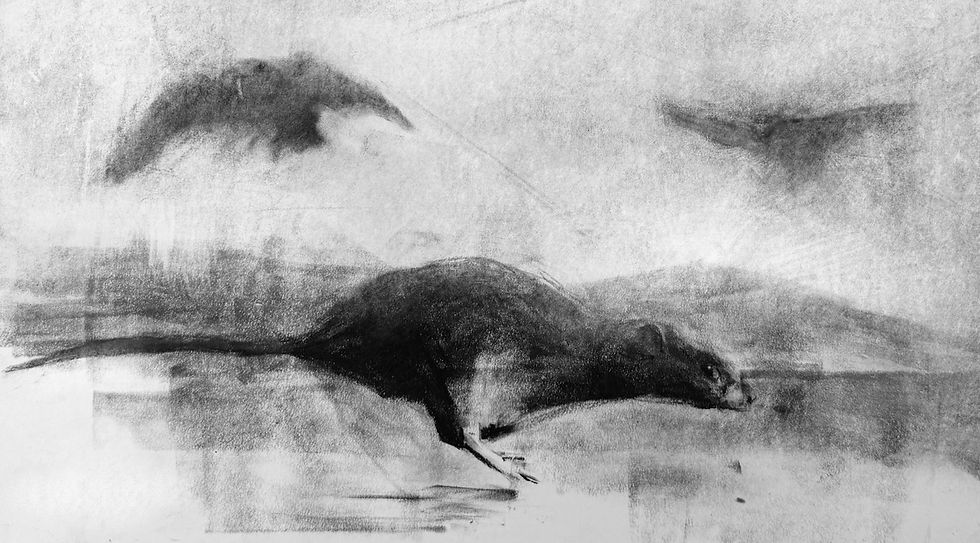
Rat escapes from the Lab
Pacon Bright White Sulphate Paper (white-white, at last). 50 lb. 18 x 24.
Jumbo charcoal underdrawing drawing. On top right, added black paint with brayer and stencil and offsetting, and pan pastel. On rat, brayer with black paint over the top with textures. Brayer with white paint on rat over the top. Mixed with charcoal to give a mid-tone. Pan pastels on top —- powder and press into wet paint. Finally, cut back in with white acrylic paint applied with knife for left side.
Highlight: Trying out materials — especially to have powder stay powdery.
Problems: ∎ Can’t get dark-darks with pan pastels. ∎ Need to find opaque white that goes over big swaths of rat — adding the brayer with white over charcoal didn’t get bright white, but mixed into mid-tone. ∎ Need more elements that scream “laboratory.”
Solutions: ∎ Try Diane Townsend and very soft pastels for opaque whites. ∎ Don’t start with charcoal everywhere! Go straight in with brayer drawing. (Try charcoal drawing with sumi ink instead.) ∎ Laboratory elements — maybe more legible rats in the cage, test tubes, bunsen burners, and modern lab coat.
This one is still sitting on my easel — what one “button” I could put on it to call it finished? Perhaps just a sparkle in the rat’s eye and whiskers.
I’d like to play around with this set up again — going much more abstract.

Doe and Dragon
Do you see them?
Pareidolia (pronounced "par-i-DOH-lee-a") is a thing. You can’t help seeing something — like faces — in a random image. A bit of a Rorschach test too, I imagine.
Drawing paper, white, more cream than white. 11 x 18, then cropped.
Left over black paint from the palette. Scrunch medium weight plastic sleeve, and dab paper. Pan pastels and erasers.
Highlight: Satisfying to do — the old brain loves it in fact. Play with darks and lights to pull out form (and personality), and set hierarchy.
Do more of these! Just respond to what’s there and see where it takes me. What could this be?


A closer look: Getting dirty at the top of the stairs. (Up and Dirty)
Working even bigger. No turning back. A ream — 500 sheets — of white white 18 x 24” paper just arrived. Standing and moving while drawing is now part of the process — to skip back far enough from the picture to see what I’m doing.
A visit to our island building materials store. Husband cut the masonite slab down to 22 x 28 pieces. Onto the on-loan easel (thank you Bainbridge Island Museum of Art).
Working just outside my little studio on the landing at the top of the stairs. The only place that is tall enough for the easel — and barely at that.

Afterword: With the spring weather, I’m finding all kinds of ways to stay outside longer. Longer walks with Charlie the dog and weeding under the apple trees. Two “reads” — audio books — that have been wonderful companions are the Heaven & Earth Grocery Store: A Novel (James McBride) and There is Nothing for You Here: Finding Opportunity in the Twenty-First Century (Fiona Hill).
Both remind me of the richness available to us when we really get to know people of cultures and backgrounds different from our own.




I always learn from your blog...this morning's lesson was on the word Procreate. I had to do a bit of googling to find it is an art term. Loved the Fiona Hill book....I, too, HIGHLY recommend it. Will try your other recommendation.