
The Words Came Easily

I swore I wouldn't share the innards of my illustrated journal. Working unobserved is what keeps me honest there. But here I am, opening a narrow window into my most recent pages. I’ve blurred the words in the examples here and am getting on with it.
I journal to give myself pause. A little “meta” time to notice what I’m experiencing. An entry starts with brief ideation (words/thumbnail captured on a back page in the same journal), followed by a first layer of tone, texture, and color. This sets the picture and page layout, which in turn shapes the writing. The whole thing takes less than an hour. Often done in short bursts over a day or two.
For 2026, I said I’d always have this kind of first layer to work against. The hypothesis: entries that start this way are the most satisfying, that they uncover the most. They did. But why?
January 2026: “Turning Point?”

A note jotted at the back of the journal reads:
Bainbridge Island march & rally in the rain. Friends and neighbors. Low key with high minor key.
That was it for the idea. Searched in my drawer for the right prepared surface. Found it. Black paper with acrylic paint on top grays, greens, and splashes of red. The low key for a gray, almost monochrome day. I drew thumbnails on an index card. Finished the idea with opaque markers to bring the tonal contrast.
The words came easily. A lot was going on that week, including the killing of Renee Nicole Good in Minneapolis, a day after our march remembering January 6.
March 5, 2026: “Feeling the Chaos of War”

The back of the journal reads simply:
Liz in Jordan. War — peace. Ryan away — close proximity. Insecure — safe. Targets — hidden/spread out. Uncertainty.
Thinking about my niece near a war zone. Enough to go on the hunt for paper to serve as a first layer that might capture it. Images of the Israeli-Palestinian conflict, in the news for months, were also top of mind.
Found it. A dynamic first layer, suggestive of buildings falling, communities drastically altered. The addition of red surfaced the human toll. Going for just enough realism in the abstraction.
A very personal slice of life followed — a reflection at the start of the US war on Iran.
March 12, 2026: “Thinking Artifacts”
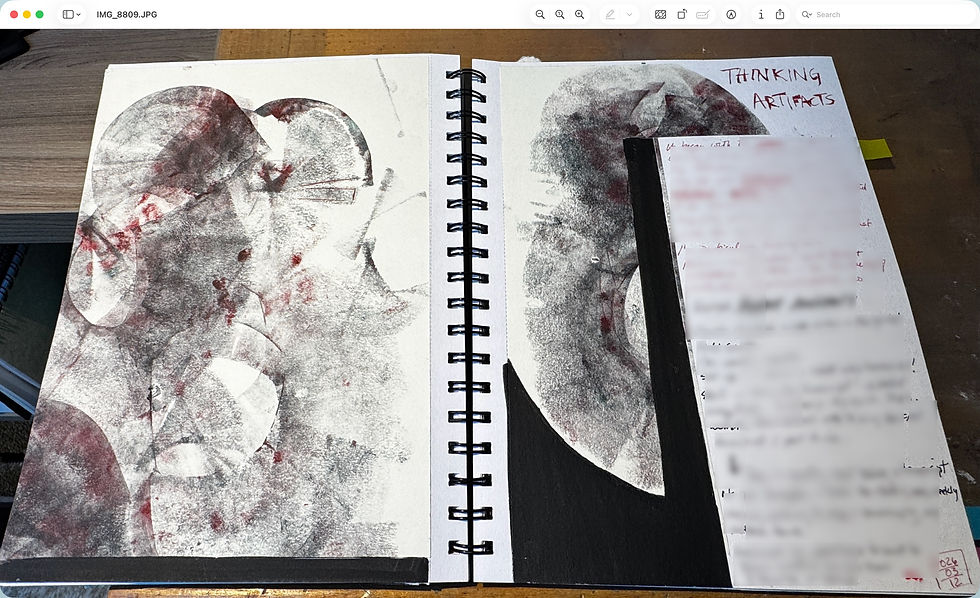
My note at the back of the journal reads:
Robot Assistant redefines how AI works for artists — we’re human, the Robot is the admin & overhead worker. Robot Assistant is the scaffolding for my life. To reduce pain points.
I went on the hunt for something geometric. In my drawer, a page with circles that reminded me of humanoid robots. Bingo. I added an eye.
The words spilled out, inelegantly capturing my first glimpse of the robot assistant I’m building. Thrilling.
So, what is it about starting with this first layer that’s so satisfying? It’s the directness of it. The first layer is the intention in physical form. It is the artifact of intention. The picture takes it further.
The words come easily after that.




Loved the insight and the simplicity of the words that moved you forward..thank you.